
Golden Jubilee
Fifty Years On

There is a particular kind of anticipation that settles over an institution as it approaches any celebration like that of fifty years. This is not the loud excitement of a new beginning, but the quieter, weightier joy of a community that has endured, and is now asking what its endurance has been for. This is where Alokolum National Major Seminary stands today: on the threshold of our Golden Jubilee, looking back at five decades of formation and looking forward, with sober hope, to what the next fifty years might demand of us.
It is no accident that this Jubilee season comes with a theme that sounds almost like a summary of the seminary’s own history: Rooted in Faith, Growing in Hope and Bearing Fruits. A jubilee, after all, is not simply a celebration of survival. From the Biblical perspective, the Jubilee year was a time of restoration, of returning to first principles, of remembering whose the land truly was, of resetting relationships that had drifted out of balance. Alokolum’s fiftieth year invites the same kind of reckoning: not nostalgia, but renewal.
Rooted: The Discipline of Memory
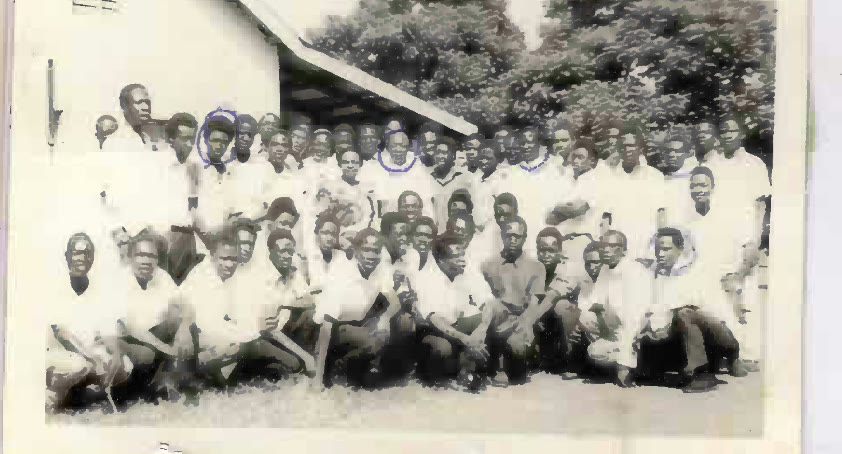
No tree bears fruit in a season it did not spend, unseen, sending roots into the dark. Alokolum’s roots run through decades of priests, bishops, formators, and ordinary seminarians whose names may never appear in any official history, but whose fidelity built the ground on which today’s community stands. To be “rooted in faith” as we approach this Jubilee is to take seriously the debt we owe to those who came before, the founding formators who had far less than we do now, the Bishops of the U.E.C. who believed a seminary in this part of Uganda was worth the sacrifice, the seminarians who persevered through years of uncertainty and, in some cases, real danger.
A Jubilee that forgets its roots becomes mere spectacle. Alokolum’s task this year is to remember well — not as an act of sentimentality, but as an act of formation. Those of us preparing for priesthood today are being asked to inherit something real, and inheritance requires knowledge of what one has received.
Growing: The Courage to Change
Yet roots alone do not make a jubilee worth celebrating. A tree that only roots itself deeper without growing upward has simply buried itself. The second movement of our Jubilee theme — growing in hope — is the harder discipline, because it requires the seminary to ask not only “what have we preserved?” but “what must we still become?”
Fifty years ago, the pastoral, cultural, and even technological landscape into which Alokolum’s sons have been ordained looks nothing like the one they serve in today. A Jubilee that is honest with itself must ask hard, astute questions: Is our formation preparing men for the Church and the world as they actually are, not as they were in 1973? Are we growing in the intellectual rigor, pastoral sensitivity, and spiritual depth that this new half-century of ministry will demand? Hope, rightly understood, is not passive optimism: it is rather the theological virtue that permits an institution to change without losing itself.
Bearing Fruits: The Only Real Measure
Ultimately, no jubilee is judged by how well an institution remembers itself or how eloquently it speaks of the future. It is judged by fruit: by the priests and other Old boys that Alokolum has formed and sent out, by the parishes strengthened, the Dioceses served, the countless quiet acts of pastoral care that trace back, however invisibly, to formation received on this sacred green Campus. The fruit of a seminary is never fully visible from within its own walls; it ripens elsewhere, in confessionals and sickrooms and homes across the region and beyond.
As we move toward this Golden Jubilee, then, the most fitting way to prepare is not merely through ceremony, but through the daily, unglamorous work of formation done well, prayer taken seriously, studies pursued with rigor, fraternity practiced with patience. Fifty years from now, someone will write about this current generation of Alokolum in exactly the terms we now use for those who built it.
A Community, Not Spectators
Perhaps the most astute thing to be said about this Jubilee is this: it does not belong to a planning committee, nor to the alumni who will return for the celebrations, nor even to the bishops who will preside over them. It belongs to everyone who has ever called Alokolum formation their own and to everyone currently within its walls being formed today. The theme asks each of us, then, a personal question disguised as an institutional one: Where are you rooted? What are you growing toward? What fruit will your own life bear?
Fifty years is a long time for an institution. It is also, providentially, exactly long enough to prove that faith, hope, and fruitfulness are not mere slogans but they are what remains when everything else has been tested.
From The Star Herald Bulletin, 27 September 2026, published by The Writer’s Club, Alokolum National Major Seminary.